

Ask someone who directly observed your work, name the opportunity, and ask whether they feel comfortable giving you a positive, specific reference. Make the request privately, include a reminder of what you worked on together, and give them an easy way to decline. Get permission before sharing their contact details; a reference request is not permission to disclose someone’s information.
- How to ask for a reference: name the opportunity, remind the person of shared work, and make declining easy.
- Choose direct observation over seniority: a useful professional reference explains what you actually contributed.
- Send reference-quality context, not a script the person must repeat.
- Voushify is pre-launch; its structured endorsements, called Voushes, are intended for shareable professional trust profiles.
Why this matters
An awkward request often leaves the other person guessing. What are you applying for? What would they need to do? Can they honestly speak to the work?
Answer those questions upfront. For your 2026 job search, the goal is not to collect impressive names. It is to help someone give an accurate account of your contribution.
Voushify is for job seekers building a shareable professional trust profile from structured recommendations. It is pre-launch; reference letters and emailed recommendations remain useful formats you can request now.
How to ask for a reference without making it awkward
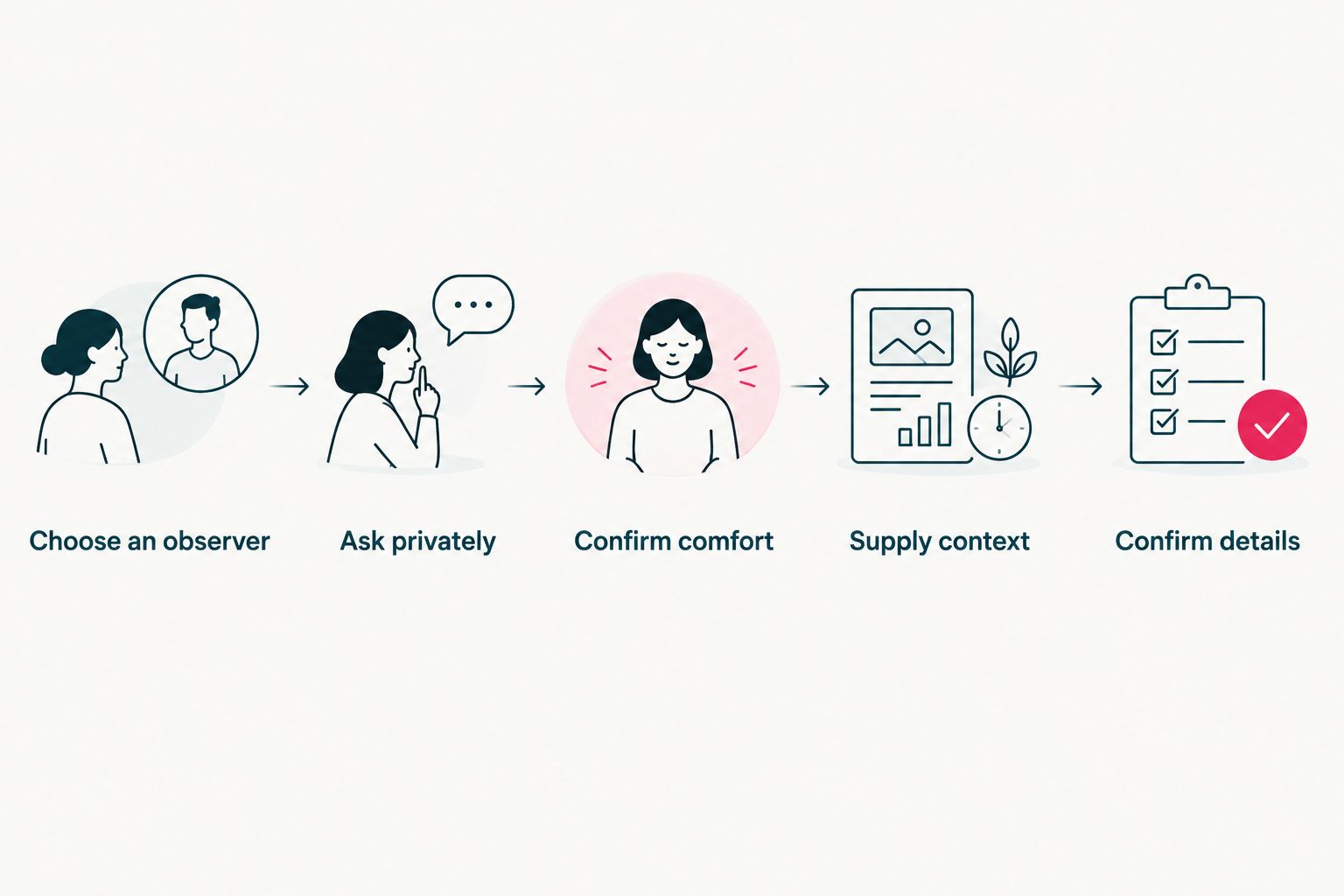
Make the request specific enough to answer and easy enough to decline. Follow this sequence before an employer contacts anyone.
1. Choose someone who saw the work
Start with the contribution you need to support. Then identify the person who directly observed it: a manager who reviewed your decisions, a colleague who worked alongside you, a professor who supervised your project, or a client who received your work.
A senior title does not substitute for firsthand knowledge. Someone who remembers your name but cannot describe your contribution gives the employer little to assess.
Ask yourself: could this person explain what I did, how they know, and where my responsibility began and ended? If not, choose another observer.
2. Ask privately and state the opportunity
Use a direct email or private message rather than putting someone on the spot in a group conversation. Name the role or type of opportunity and explain why you thought of them.
Be explicit about the request. Being listed as a contact, writing a letter, and providing an emailed recommendation are different commitments. If the employer has not explained the process, say that rather than promising a quick call.
3. Ask about comfort, not just permission
Ask whether the person feels comfortable providing a positive, specific reference based on your work together. This creates room for an honest answer before you submit their name.
Avoid pressure disguised as reassurance. Saying that someone only needs to say something nice asks for praise, not evidence. Your reference should describe what they actually observed.
4. Supply context after they agree
Send the job description, your current résumé, the requested format, and any employer-provided deadline. Add a short reminder of relevant shared work.
Keep your own contribution distinct from the team’s result. A factual prompt helps someone remember; an exaggerated summary asks them to endorse a claim they cannot support.
5. Confirm contact details and close the loop
Ask which email address or phone number they want you to share. Confirm what the employer has said about contact, timing, and submission instructions.
Thank them after they agree and after they provide the reference. If the application changes or you withdraw, tell them so they are not waiting for an unexplained request.
What should you say in a reference request email?
Use the template as a starting point, not a form letter. Replace each descriptive phrase with accurate details before sending it.
Illustrative email template: asking a former manager
Subject: Reference request for a project coordinator application
Hi Morgan,
I’m applying for a project coordinator role and wanted to ask whether you would feel comfortable being a professional reference for me.
I thought of you because you directly reviewed my work on our scheduling project, including the handover documentation I prepared. The role involves coordinating deadlines and keeping project records clear.
If you’re comfortable, I can send the job description, my current résumé, and the reference instructions. Please feel free to decline if the timing is difficult or you don’t feel you have enough detail to comment.
Thank you for considering it.
The useful parts are the relationship, the observed work, and the clear request. None depends on making the message overly formal.
Do not attach a long dossier to the first message unless the person has asked for it. Establish willingness first. Then send the material they need.
How do you ask a professor or someone you haven't contacted recently?
Reintroduce yourself through shared work, not an apology for existing. Give the person a concrete memory cue and explain why their perspective fits the opportunity.
A professor who supervised a substantial project can discuss that project. Do not ask them to describe workplace performance they never observed.
Asking a professor
Illustrative email template: a 2026 internship application
Hello Professor Rivera,
I’m applying for a research internship and wanted to ask whether you would feel comfortable providing a reference based on the project you supervised.
My project examined how participants interpreted the survey questions. Your feedback helped me revise the method and explain its limitations. The internship asks for evidence of research judgment and clear written communication.
If that feels like a suitable basis for a reference, I can send my project summary, résumé, and the application instructions. I understand if you do not feel you have enough information to comment.
Reconnecting with a former colleague
Start with the team, project, or responsibility you shared. Then ask whether the person remembers enough detail to provide a reference.
Illustrative opening:
Hi Jordan, we worked together on the customer onboarding documentation. I’m applying for a role involving process writing and wanted to ask whether you remember enough of that work to feel comfortable being a reference.
Do not treat a warm response as agreement to be a reference. Ask the question directly and wait for an explicit answer.
Which reference format should you request?
Follow the employer’s instructions before choosing a format. A strong letter does not replace a required reference conversation, and a contact name does not replace a requested written recommendation.
| Format | Best for | Useful signal | Limitation |
|---|---|---|---|
| Reference contact | An employer requesting a conversation | Follow-up questions about observed work | Requires the person’s agreement and coordination |
| Reference letter | An application requesting a formal document | A written account tailored to the application | Revisions require another request to the writer |
| Emailed recommendation | A request that accepts a written email | Direct written context from the recommender | Forwarding requires care with permission and private information |
| Voushes | Professionals seeking structured, shareable endorsements | Organizing recommendations into a professional trust profile | The platform is pre-launch; follow current application requirements |
Reference letters and emailed recommendations are not outdated or inferior. Their usefulness depends on what the recipient needs and whether the writer supplies specific evidence.
Voushify turns recommendations from colleagues, managers, professors, and clients into structured endorsements called Voushes. Voushify is best for job seekers who want to build a shareable professional trust profile from people who observed their work. Join the waitlist if that approach fits your needs; do not delay an active application while waiting for the product.
Join the waitlist
Follow Voushify’s pre-launch platform for structured professional endorsements called Voushes.
Why reference requests vary
The right wording depends on what you are asking someone to substantiate. Adjust these parts of the request rather than sending everyone the same message:
- Relationship: A manager, professor, colleague, and client observed different parts of your work. Name the relevant setting.
- Recency: Someone you have not contacted recently needs a stronger reminder of the work you shared.
- Format: A letter, email, and conversation require different preparation. State the requested format when you know it.
- Relevance: Connect the observer’s knowledge to the role’s actual responsibilities, not every line of the job description.
- Confidentiality: A current employer or client relationship needs particular care. Explain what can be shared and with whom.
- Timing: Use the employer’s actual deadline. Do not describe a late request as effortless or assume the person can accommodate it.
What should you send after someone agrees?
Send a compact reference brief. Its job is to make accurate recall easier, not to coach someone into repeating your preferred assessment.
Reference request checklist for 2026
Include these items in a clearly organized message:
- Opportunity: The role title and the job description or application instructions.
- Shared work: One relevant project or responsibility the person directly observed.
- Your contribution: Two or three factual bullets separating your actions from the team’s work.
- Process: The requested format, known deadline, and submission instructions.
- Permission: Confirmation of which contact details you can share.
For example, ask the person to recall how you documented a handover, resolved conflicting feedback, or explained a decision. Those are starting points for their memory, not claims you should supply without evidence.
A reference-quality statement explains the work and the observer’s basis for knowing it. A falsifiable claim is a statement that can be checked against what happened: preparing a particular handover document is more concrete than being an exceptional teammate.
Do not add a result, percentage, or accomplishment unless it is accurate and the reference can support it. Specificity does not require a metric.
Can you ask a coworker instead of a manager?
Ask a coworker when they directly observed relevant work and the employer accepts that relationship. Describe the relationship accurately rather than presenting a peer as your supervisor.
A coworker can explain collaboration and shared delivery. They should not be asked to confirm a performance review, reporting responsibility, or management decision they did not see.
Should you follow up if someone doesn't reply?
Send a brief follow-up that repeats the request and makes declining easy. If a real deadline is approaching, state it plainly and prepare to ask another suitable person.
Silence is not consent. Do not list the person because you assume they would agree, and do not send repeated messages that turn a favor into an obligation.
What if someone says no?
Thank them and choose another observer. You do not need to persuade someone to provide a reference they are uncomfortable giving.
If they explain that they cannot remember enough detail, accept that limit. A willing reference with direct knowledge is a better choice than a reluctant name with an impressive title.
FAQ
What's the best way to ask for a reference in 2026?
Ask privately, name the opportunity, and ask whether the person feels comfortable giving a positive, specific reference. Remind them of relevant work they directly observed and give them an easy way to decline.
Can I list someone as a reference without asking first?
Get explicit permission before listing someone as a reference or sharing their contact details. Confirm which details they want you to use and explain the employer’s known process.
How do I ask for a reference when I have no job experience?
Ask someone who observed relevant work in a course, project, internship, or volunteer setting, subject to the application’s requirements. Explain the relationship accurately and focus on contributions they can describe firsthand.
Should I ask for a reference by email or in person?
Use a private channel that lets the person consider the request without pressure. Email gives you space to explain the opportunity; if you ask in person, send the details afterward in writing.
What should I do if the reference deadline is soon?
State the actual deadline immediately and acknowledge the short notice. Make declining easy and identify another suitable observer rather than assuming the person can respond in time.
Can I reuse a recommendation letter for another application?
Ask the writer’s permission before reusing a recommendation letter for a different application. Check whether the new recipient requires a tailored letter or direct submission from the writer.
Can I use Voushify for references today?
Voushify is pre-launch, so join the waitlist rather than planning to use the product for a current application. Follow the employer’s existing requirements for reference contacts, letters, or emailed recommendations.
One last thing
Your best reference starts with a memory, not an adjective. Before sending your next request, write down the specific moment you hope the person remembers.
For your 2026 search, ask whether that moment demonstrates a responsibility the new role actually requires. If it does, include it as a factual reminder. If it does not, find a more relevant example—or a different observer.